Menopause and Its Medication Management in Nepal
November 24, 2026
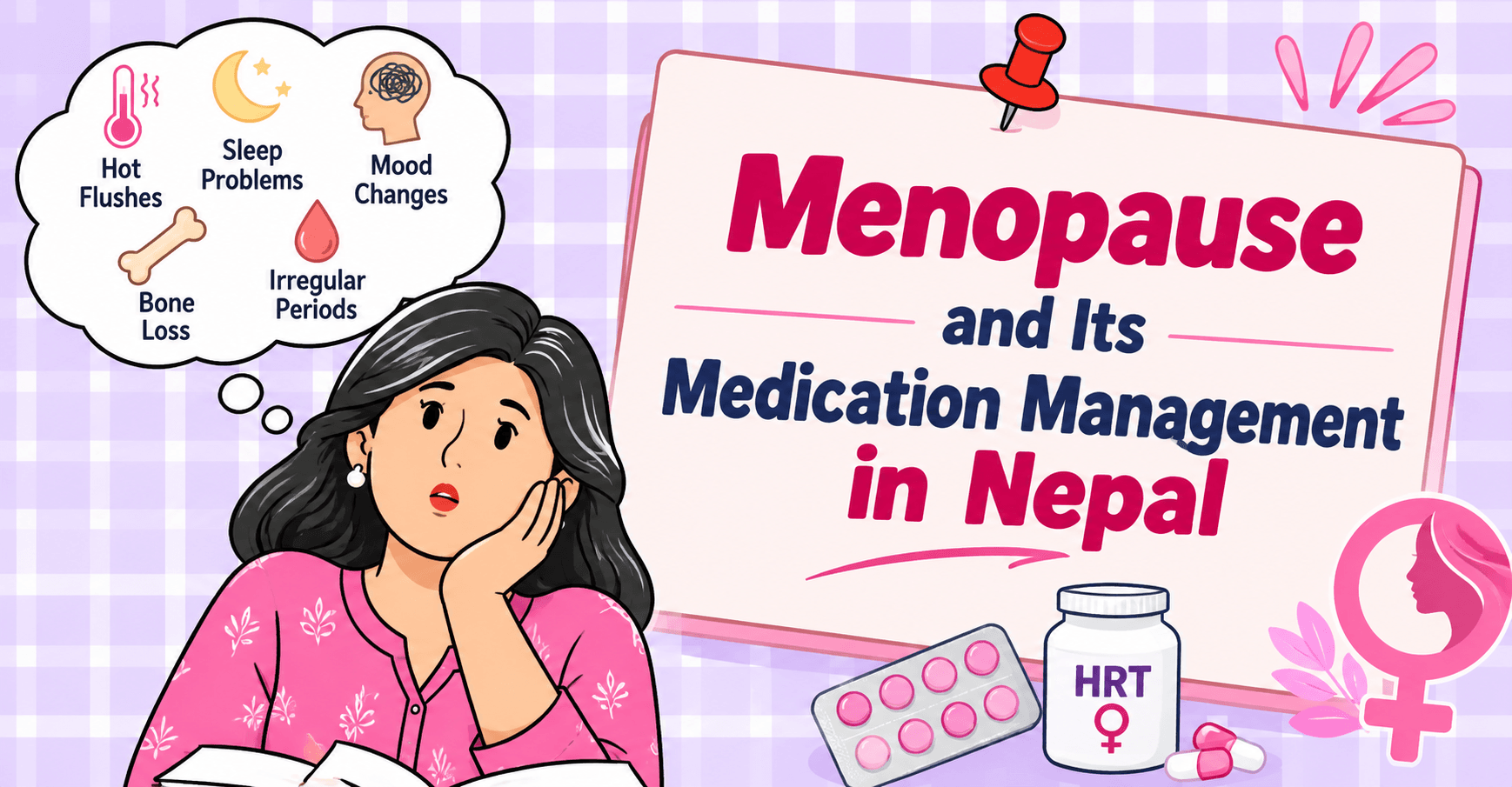
Menopause arrives without announcement or explanation for many Nepalese women. Periods become irregular, nights are disrupted by sweating, sleep deteriorates and mood changes feel unfamiliar. In many households the experience is met with silence, or with the remark that “it happens to every woman.” Menopause is a natural stage of life, yet in Nepal it remains one of the least discussed aspects of women’s health.
1. Menopause in Nepal
Age and awareness: In the MESON study, 41% of women had reached menopause, with a mean age of 48.7 years. About 59.2% had limited knowledge of menopause, indicating a clear need for awareness and education [1].
Symptoms: Irritability, sleep problems, depressive mood and hot flushes were the most common complaints. Hot flushes were reported by 38% of women in Kapilvastu and 81.9% in Kavrepalanchok, reflecting a considerable symptom burden [2,5].
Access and stigma: Limited awareness, misconceptions and social barriers can prevent women from seeking care. Better education and open discussion can encourage timely healthcare-seeking.
Hormone therapy use Use of hormone replacement therapy (HRT) has historically been low in developing countries, particularly among women with limited access to care. Use is influenced by awareness, affordability, education and urban–rural differences [6].
Treatment and quality of life: In Pokhara, women receiving medication or treatment were more likely to report better quality of life (adjusted odds ratio [AOR] 4.83), showing that appropriate symptom management improves well-being [4].
2. Medication Management
2.1 Initial Assessment
Before any treatment, assess the following: symptoms (the Menopause Rating Scale has been used in Nepal), age, time since the last period, bleeding pattern, and cardiovascular, breast, clotting and liver risk.
2.2 Menopausal Hormone Therapy (MHT/HRT)
MHT is the most effective treatment for hot flushes and night sweats. It also relieves vaginal symptoms and protects bone.
• Women with a uterus need oestrogen plus a progestogen to protect the endometrium.
• Women without a uterus can take oestrogen alone.
• Transdermal oestrogen is generally preferred for women at higher risk of clots or stroke.
• Start at the lowest effective dose and review regularly.
• MHT is not recommended in women with a history of breast cancer, unexplained vaginal bleeding, active liver disease or a prior clot, among other conditions.
2.3 Vaginal Oestrogen
Low-dose local oestrogen treats vaginal dryness and urinary symptoms with minimal absorption into the body.
2.4 Non-hormonal Treatment
For women who cannot or prefer not to use hormone therapy, several non-hormonal options are available for vasomotor symptoms.
2.5 Bone, Cardiovascular and Metabolic Health
Adequate calcium and vitamin D3 intake is necessary for bone health. Menopause management should not focus only on hot flushes. Assessment should also cover blood pressure, weight/BMI and waist circumference, lipid profile, diabetes risk, smoking or tobacco exposure, physical activity and other cardiovascular risk factors. Drug therapy should be individualised to the patient’s condition.
Summary of Drug Options (Generic Names)
Category --------------- Examples ------------- Main use
Oestrogens (systemic): Estradiol; estradiol valerate; estradiol hemihydrate Hot flushes, night sweats, bone protection
Progestogens: Micronised progesterone; dydrogesterone; norethisterone; medroxyprogesterone acetate Endometrial protection when the uterus is present
Vaginal oestrogen: Conjugated oestrogen vaginal cream Vaginal dryness, urinary symptoms
Antidepressants: SSRIs/SNRIs Hot flushes (non-hormonal)
Other non-hormonal drugs: Gabapentin; pregabalin; clonidine; oxybutynin Hot flushes (non-hormonal)
Neurokinin antagonists: Fezolinetant; elinzanetant (where available) Hot flushes (non-hormonal)
Bone health: Calcium; vitamin D3 Bone protection
3. Menopause Screening in Nepal
In Nepal, menopause is usually identified from the woman’s menstrual history and symptoms rather than routine blood tests.
3.1 Menopause Rating Scale (MRS)
A simple questionnaire that assesses the severity of common symptoms such as hot flushes, sleep problems, mood changes, joint and muscle discomfort and vaginal dryness. A Nepalese study of 729 women aged 40–65 years found that an MRS score of 16 or above could serve as a screening threshold for referral for severe menopausal symptoms [3].
3.2 Clinical Assessment
For women around the usual age of menopause, assessment should include:
• Menstrual history: irregularity or 12 months without menstruation
• Vasomotor symptoms: hot flushes and night sweats
• Sleep and mood changes
• Genitourinary and sexual symptoms
• Medical history and cardiovascular and metabolic risk factors
3.3 FSH Testing
A follicle-stimulating hormone (FSH) blood test is not routinely needed for women aged 45 years or above with typical menopausal symptoms. It may be considered in younger women when early or premature menopause is suspected.
References
1. Rajbhandari, S., Subedi, R. K., Dangal, G., Phuyal, A., Vaidya, A., Karki, A., Tuladhar, H., Sharma Gurung, B., Joshi, L., & Shrestha, S. (2017). Menopausal health status of Nepalese women (Menopause Society of Nepal [MESON] study). Journal of Nepal Medical Association, 56(205), 107–111. https://pdfs.semanticscholar.org/f1b9/7545ac203bf2cdd82792ac33e34eebd69de7.pdf
2. Ghimire, N., Dhakal, P., Norrish, D., et al. Menopausal health status of women of Kapilvastu district. Journal of Nepal Health Research Council. https://jnhrc.com.np/index.php/jnhrc/article/download/3983/3985
3. Chuni, N., & Sreeramareddy, C. T. (2011). Frequency of symptoms, determinants of severe symptoms, validity of and cut-off score for Menopause Rating Scale (MRS) as a screening tool: A cross-sectional survey among midlife Nepalese women. BMC Women’s Health, 11, 30. https://doi.org/10.1186/1472-6874-11-30
4. Baral, S., & Kaphle, H. P. (2023). Health-related quality of life among menopausal women: A cross-sectional study from Pokhara, Nepal. PLoS ONE. https://doi.org/10.1371/journal.pone.0280632
5. Quality of life of menopausal women in Majhifeda VDC, Kavrepalanchok. Kathmandu University Medical Journal. https://www.kumj.com.np/issue/64/311-316.pdf
6. Sharma, S. (2003). Hormone replacement therapy in menopause: Current concerns and considerations. Journal of Nepal Medical Association. https://nepmed.nhrc.gov.np/entities/publication/6f816898-5a8c-4314-b294-3d6a9c87c359/full
7. National Institute for Health and Care Excellence. (2026). Menopause: Identification and management (NICE guideline NG23). https://www.nice.org.uk/guidance/ng23/chapter/Recommendations
Innovating Healthcare, Transforming Futures:
Nepal Remedies, Your Partner in Hormonal and Steroids Excellence.